Thessaloniki
 Greece
Greece's second city, a Byzantine and Ottoman seaport with the best food in the country and a huge student population.
Overview
Thessaloniki has been continuously inhabited for over 2,300 years and served as the second city of the Byzantine Empire and a major Ottoman port with a large Sephardic Jewish community until the Second World War. A fire destroyed much of the centre in 1917, so the city is a layered mix of Roman ruins, Byzantine churches, Ottoman baths, interwar apartment blocks and postwar concrete, all along a waterfront promenade that runs five kilometres around the bay. Aristotle University is the largest in the Balkans and gives the city an outsized student population, which drives an unusually good and unusually cheap bar, music and food scene. Costs are the lowest of any major city in the eurozone outside a handful of places, the airport connects across Europe, and Halkidiki's beaches, Mount Olympus and the monasteries of Meteora are all within a couple of hours.
Why Expats Love It
Very low costs, a walkable seafront city, and food that Greeks themselves rate above Athens. The student energy keeps prices down and nightlife constant, and the Balkan and Anatolian influences make the culture distinct from the islands. Remote workers get Greece's digital nomad visa and a substantial tax incentive scheme for new residents, plus sun, sea and mountains in every direction. It is also a genuine city rather than a tourism economy, so daily life feels normal rather than performed.
Must Dos
The essential, top gem experiences for the full tourist experience.
White Tower and the waterfront
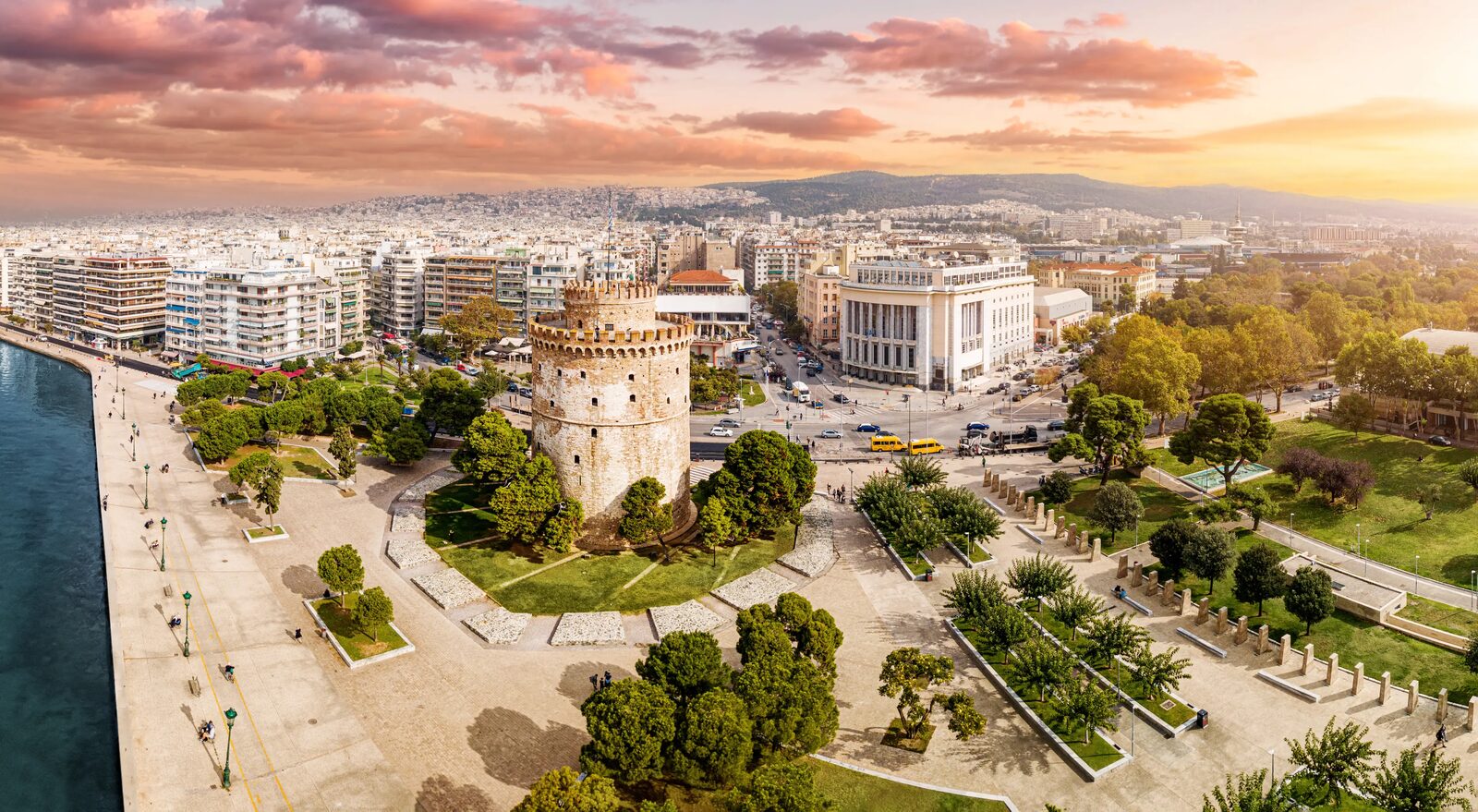
The sixteenth-century Ottoman tower is the city symbol, with a spiral museum of city history inside and a rooftop view over the bay to Mount Olympus on clear days. The promenade running both directions from it is where the whole city walks in the evening.
Ano Poli and the Byzantine walls
The upper town escaped the 1917 fire, so it keeps Ottoman timber houses, narrow lanes and the Eptapyrgio fortress. Walk up through it at sunset for the best panorama and eat at one of the tavernas around Tsinari.
Rotunda and the Arch of Galerius
A Roman mausoleum from around 306 AD, later a church and then a mosque, still with its minaret standing outside, near the triumphal arch of the same emperor carved with battle reliefs. Both sit in the middle of the modern city.
Church of Agios Dimitrios
The five-aisled basilica over the crypt where the city's patron saint was martyred in a Roman bath, holding surviving seventh-century mosaics that escaped the fire. It is one of fifteen UNESCO-listed Palaeochristian and Byzantine monuments in the city.
Modiano and Kapani markets
The restored Modiano covered market and the adjacent open Kapani market are the food heart of the city, dense with fish, olives, spices and small ouzeri. Eat mussels and drink tsipouro at a standing counter.
Museum of Byzantine Culture
One of the best museums in Greece, tracing the city's Byzantine centuries through mosaics, icons, tomb frescoes and everyday objects, and it is far less crowded than anything comparable in Athens.
Off the Beaten Path
Live like a local. Special, lesser known experiences for adventurers who want real local flavor.
Jewish Museum and the Modiano legacy
Before 1943 the city was around a fifth Sephardic Jewish and was known as the Mother of Israel. The small museum on Agiou Mina and the surviving Monastirioton synagogue tell a history that the city has only recently begun to foreground.
Bey Hamam and Bezesteni
An Ottoman bathhouse from 1444 on Egnatia street, and the domed Bezesteni cloth market nearby, both still standing among modern shops and usually walked past without a glance.
Ataturk's birthplace
The founder of modern Turkey was born in Thessaloniki in 1881, and the house is preserved as a museum inside the Turkish consulate grounds. Entry requires ID and it draws almost entirely Turkish visitors.
Valaoritou district after dark
A grid of interwar textile warehouses colonised by bars, live music venues and studios, with almost no signage and a crowd that is entirely local. It is the best nightlife in northern Greece and invisible in daylight.
Mount Olympus from Litochoro
Ninety minutes south, the Enipeas gorge trail climbs from Litochoro village toward the refuges below the summit ridge. A day hike to the Prionia trailhead and back is achievable, and the full ascent takes two days.
Kerkini Lake
An artificial wetland near the Bulgarian border, an hour and a half north, with Dalmatian pelicans, water buffalo and flat-bottomed boat trips at dawn. It is one of the best birdwatching sites in Europe and sees very few foreign visitors.
Cost of Living
1-Bedroom Apartment (City Center)
$450/mo
3-Bedroom Apartment (City Center)
$800/mo
Restaurant Meal
$13
Monthly Groceries
$250/mo
Monthly Transportation
$30/mo
Monthly Healthcare
$70/mo
Climate
Thessaloniki has a humid subtropical climate on the edge of Mediterranean, with hot summers above 32C, and winters colder than southern Greece, occasionally dipping to freezing with rare snow. The Vardaris wind blows cold and hard down from the north in winter.
Best Time to Visit
April to June, and September to October
Visa & Residency
Written for US citizens
Greece is in the Schengen Area, allowing 90 days in any 180-day period visa-free for Americans and many other nationals. Longer stays are available through the Greek digital nomad visa for remote workers meeting a monthly income threshold from foreign sources, the financially independent person visa, student permits and employment permits. Greece also runs a non-domicile tax regime offering a flat rate to qualifying new residents, and a 50 percent income tax exemption for certain relocating professionals. Confirm with a Greek consulate before applying.
These notes assume a US passport. If you hold a different nationality, your visa options and timelines may vary. Always confirm current rules with the official embassy or consulate before you commit.
Safety
Thessaloniki is safe, with low violent crime. Pickpocketing occurs around Aristotelous Square and the Modiano market area, and the university district sees regular student protests that can involve tear gas and road closures, generally announced in advance. Pavements are poorly maintained and cars park on them routinely, so walking requires attention. Motorbike traffic is fast and unpredictable.
Healthcare
Residents access the ESY national system through social security contributions, and standards at the AHEPA and Papageorgiou university hospitals are solid, though public underfunding means queues and gaps in supplies. Most expats carry private insurance, which is inexpensive, and use private clinics such as Interbalkan Medical Center, which is well equipped and used by patients from across the Balkans. English-speaking doctors are readily found.
Culture & Lifestyle
Culture
Thessalonians consider themselves distinct from Athenians, with a slower, more sociable rhythm and pride in the city's Byzantine and multicultural past. Coffee culture is serious and sitting for two hours over one frappe is entirely normal. Hospitality toward foreigners is genuine, family ties are strong, and bureaucracy is slow enough that patience is a survival skill. Learning Greek is difficult but even the alphabet and basic phrases change how you are received.
Lifestyle
Life happens on the waterfront and in the cafes. Residents walk or cycle the Nea Paralia promenade at sunset, eat late in the Ladadika and Valaoritou districts, and take weekend trips to Halkidiki beaches in summer and Mount Olympus or Pieria for hiking. The new metro, opened after decades of archaeological delays, has changed commuting. Ano Poli, the Ottoman upper town that survived the fire, is the most desirable residential area for the views and the quiet.
Language
Greek, with English widely spoken among students and younger residents
Currency
Euro (EUR)
Timezone
EET (UTC+2), EEST (UTC+3) in summer