Rotterdam
 Netherlands
Europe's biggest port rebuilt as an architecture laboratory, with Dutch quality of life at below-Amsterdam prices.
Overview
Rotterdam lost almost its entire centre to bombing in May 1940, and instead of reconstructing what was lost it built something new. The result is the only genuinely modern skyline in the Netherlands, a city of experimental buildings, wide boulevards and a working river port that remains the largest in Europe. It is young, diverse and unpretentious, with roughly half the population having a migration background and more than 170 nationalities represented. Erasmus University and a large creative sector keep the energy up, and the city has spent two decades converting derelict dockland into housing and cultural space, most visibly on the Kop van Zuid across the Erasmus Bridge. For foreigners it works well: English is near universal, cycling infrastructure is world class, Amsterdam and Schiphol are 25 to 40 minutes away by train, and housing costs, while rising, sit clearly below the capital.
Why Expats Love It
You get Dutch systems, safety, cycling and transport with more space, lower rent and less tourism than Amsterdam. The architecture and design culture attracts a specific kind of person, the food scene has become genuinely good, and the international business community around the port and Erasmus University makes professional networking straightforward in English. The city also has a self-made, no-nonsense attitude that many newcomers find easier to plug into than older, more established Dutch cities.
Must Dos
The essential, top gem experiences for the full tourist experience.
Markthal
A horseshoe of apartments arched over a food market hall, with an 11,000 square metre interior mural of fruit and flowers. Come for the produce, the Surinamese and Turkish stalls and the cheese, and note that the apartments have windows opening into the hall.
Cube Houses and the Blaak district
Piet Blom's tilted yellow cubes on stilts from 1984, with one unit open as the Kijk-Kubus museum house so you can see how the sloping walls actually work. The neighbouring Pencil Tower and Central Library complete the set.
Museum Boijmans Van Beuningen Depot
The world's first fully accessible art storage facility, a mirrored bowl in the Museumpark holding the entire collection in visible racks, with a rooftop birch forest and restaurant. The main museum is under renovation, so the Depot is the way to see the collection.
Erasmus Bridge and the Kop van Zuid
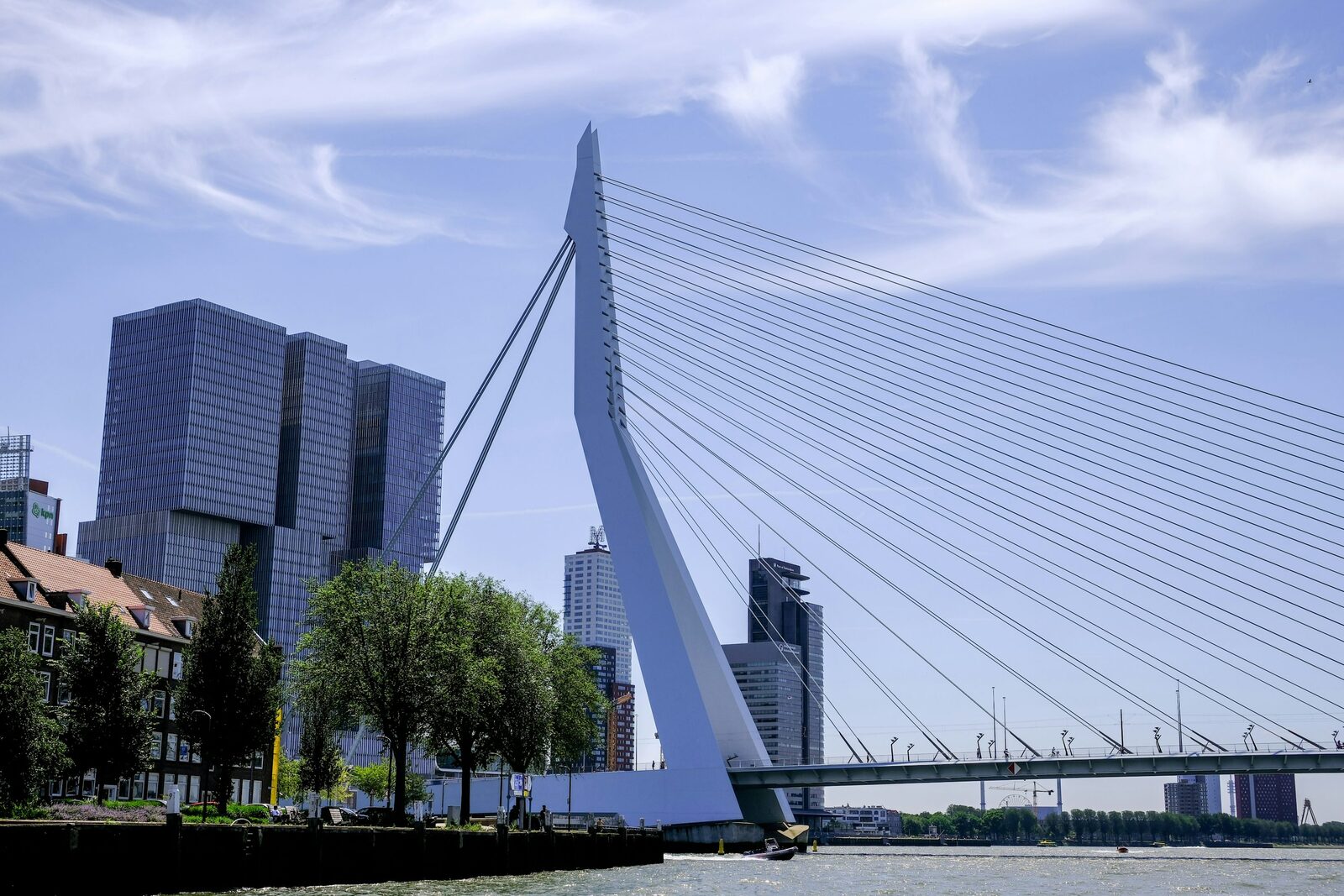
Walk or cycle the white swan-shaped bridge to the redeveloped southern docks, where the Hotel New York occupies the old Holland America Line headquarters that shipped emigrants to Ellis Island. The Fenix Food Factory and the Rijnhaven waterfront are just beyond.
Delfshaven
The only surviving pre-war corner of the city, with a canal of seventeenth-century gabled houses, a working windmill and the Pilgrim Fathers church from which the Speedwell sailed in 1620. It is a fifteen-minute metro ride and a completely different Rotterdam.
Euromast
A 185-metre observation tower with a rotating glass Euroscoop cabin, giving a full view of the port, the river and on clear days as far as The Hague. Adventurous visitors can abseil down the outside in summer.
Off the Beaten Path
Live like a local. Special, lesser known experiences for adventurers who want real local flavor.
Hotel New York water taxi to Katendrecht
Take the fast water taxi across the Maas to Katendrecht, once the red-light and Chinatown district and now the city's best eating quarter, anchored by the Fenix Food Factory in an old warehouse and the Deliplein theatre square.
Van Nelle Factory
A 1930s daylight factory in glass and steel, UNESCO listed as a masterpiece of functionalist industrial architecture and now an office and events complex. Guided tours run periodically and the exterior alone is worth the trip out to Spaanse Polder.
Trompenburg Gardens and Arboretum
A private botanical garden in Kralingen with more than 4,000 plant species, a Victorian layout and glasshouses, almost never busy. Combine with the Kralingse Plas lake and its two eighteenth-century windmills.
Maritiem District and the Wereldmuseum
The old harbour basin of Leuvehaven filled with historic ships alongside the ethnographic Wereldmuseum. The floating pavilion and the Maritiem Museum's outdoor harbour are free to walk around.
Hoek van Holland by metro line B
The metro runs all the way to the North Sea, ending at a wide dune beach where the Nieuwe Waterweg shipping channel meets the sea. You can sit and watch container ships pass at close range, and the bunkers of the Atlantic Wall line the dunes.
Zuiderpark and the Afrikaanderwijk market
The Wednesday and Saturday Afrikaandermarkt in Rotterdam Zuid is the most diverse street market in the country, heavy on Turkish, Moroccan, Surinamese and Cape Verdean stalls. It is where the city's real demographics are visible.
Cost of Living
1-Bedroom Apartment (City Center)
$1250/mo
3-Bedroom Apartment (City Center)
$2000/mo
Restaurant Meal
$20
Monthly Groceries
$340/mo
Monthly Transportation
$75/mo
Monthly Healthcare
$145/mo
Climate
Rotterdam has a temperate maritime climate with cool summers around 22C, mild winters that hover just above freezing, and rain spread evenly through the year. Wind off the North Sea is a constant factor, particularly on the exposed river and dock areas.
Best Time to Visit
May to September
Visa & Residency
Written for US citizens
The Netherlands is in the Schengen Area, allowing 90 days in any 180-day period visa-free for Americans and many other nationals. Longer stays need a residence permit, with the highly skilled migrant route through a recognised sponsor employer being the most common, alongside the EU Blue Card, the orientation year permit for recent graduates of top universities, the startup visa, and the DAFT self-employment route which lets US citizens establish a business with a relatively low capital requirement. Registration with the municipality for a BSN number is required within five days of arrival.
These notes assume a US passport. If you hold a different nationality, your visa options and timelines may vary. Always confirm current rules with the official embassy or consulate before you commit.
Safety
Rotterdam is safe, with the usual big-city caveats. Bike theft is the most common crime by a wide margin, so use two locks and never leave a good bike out overnight. Pickpocketing occurs around Centraal Station and on busy tram routes. Some outer southern districts have higher deprivation and petty crime, though tourists and most residents have no reason to be there at night. Cycling requires attention to tram tracks and scooter lanes.
Healthcare
Dutch health insurance is mandatory for residents and bought from private insurers under a regulated basic package, with a monthly premium and an annual deductible. Care is routed through a huisarts, the general practitioner, who acts as gatekeeper to specialists, so registering with one early matters. The Erasmus MC is one of the largest and best-regarded university hospitals in Europe. Dutch GPs are known for conservative prescribing, which can surprise Americans.
Culture & Lifestyle
Culture
Dutch directness is real and is not rudeness. Opinions are stated plainly, meetings start on time, and social plans are made weeks ahead in a shared calendar. Rotterdam adds a working-class, get-on-with-it edge that distinguishes it from the rest of the country. Learning Dutch is not strictly necessary but it changes how much of the city you see, and locals will usually switch to English at the first hesitation unless you ask them not to.
Lifestyle
Everything happens by bike. Residents commute across the Erasmus Bridge, shop at the Markthal and the Saturday Binnenrotte market, and spend summer evenings on the roof terraces of Witte de Withstraat or on the Kop van Zuid waterfront. Weekends bring gallery openings, the beach at Hoek van Holland by metro, and easy day trips to Delft, The Hague and the Kinderdijk windmills. Nightlife is club-driven and runs later than most Dutch cities.
Language
Dutch, with English spoken at a very high level across the city
Currency
Euro (EUR)
Timezone
CET (UTC+1), CEST (UTC+2) in summer