
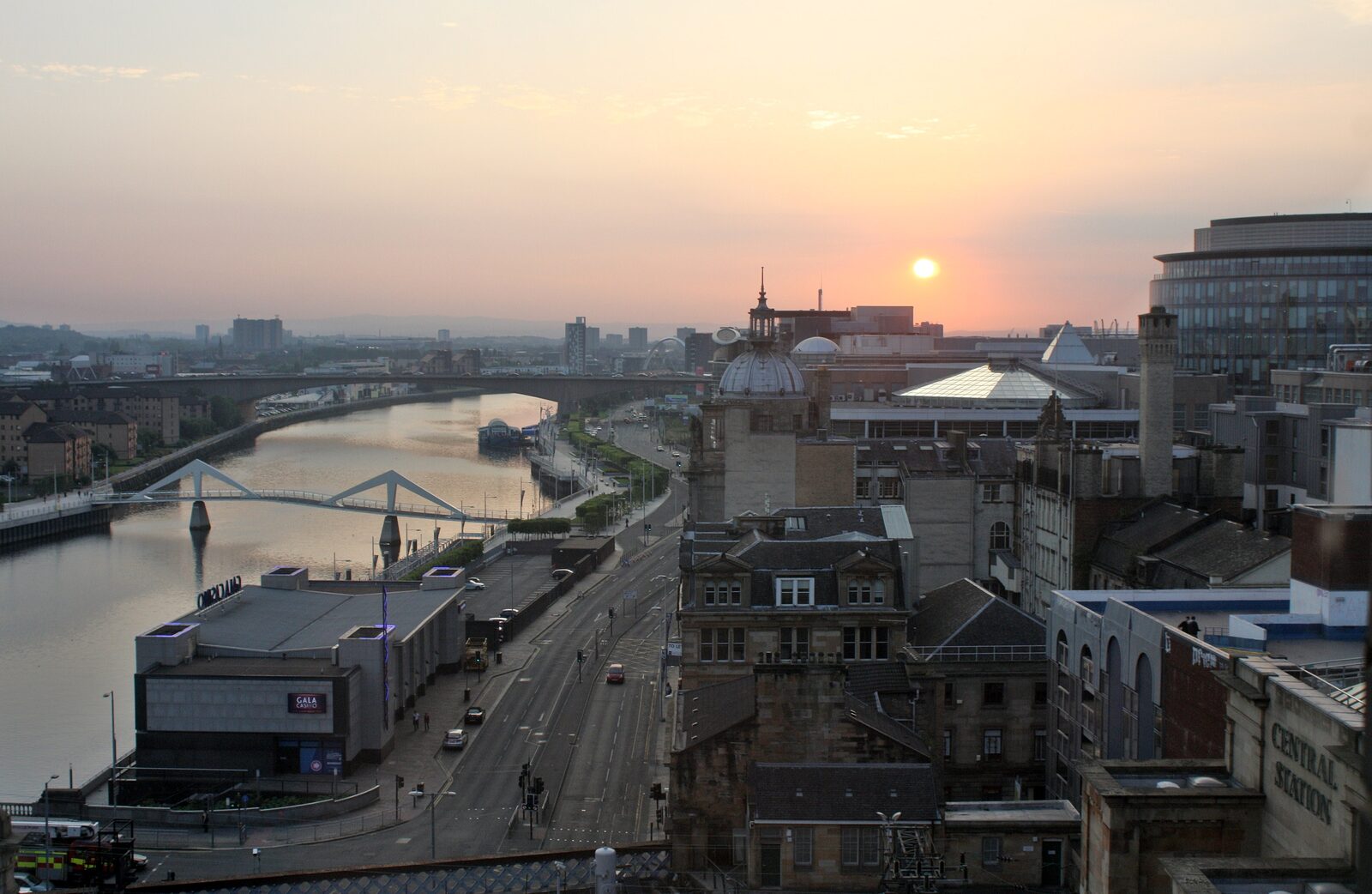
Glasgow
 United Kingdom
Scotland's biggest city, Victorian and post-industrial, with the best music scene in Britain and low costs.
Overview
Glasgow was the second city of the British Empire, built on shipbuilding, engineering and tobacco, and its Victorian grid of sandstone tenements and grand civic buildings reflects that wealth. Industrial collapse hit hard in the twentieth century, and the city has spent forty years rebuilding around culture, education, healthcare and creative industries. It has three universities, the largest student population in Scotland, and a music scene that has produced a steady run of internationally significant bands and remains dense with venues. The West End around the university is leafy and cafe-lined, the Southside is increasingly the centre of gravity for families and independent food, and the city centre and Merchant City hold the nightlife. Edinburgh is fifty minutes by train, the Highlands and Loch Lomond start within an hour, and Glasgow is markedly cheaper than any comparable English city.
Why Expats Love It
It is the most affordable major city in the UK, with sandstone flats at a fraction of London prices and free university tuition for eligible residents in Scotland. The people are famous for being direct and welcoming, the cultural offer is disproportionate to the size, and the Highlands and islands are genuinely accessible for weekends. The NHS, walkable neighbourhoods, and a large international student and healthcare workforce make it easy to settle, and the airport connects to Europe and North America.
Must Dos
The essential, top gem experiences for the full tourist experience.
Kelvingrove Art Gallery and Museum
A red sandstone palace in the West End holding Dali's Christ of Saint John of the Cross, Scottish colourists, a Spitfire hung from the ceiling and free organ recitals daily. Entry is free and it is the most visited museum in Scotland.
Glasgow School of Art and the Mackintosh trail
Charles Rennie Mackintosh defined the city's architectural identity, and although the art school building was lost to fire, the Mackintosh at the Willow tearooms, House for an Art Lover and the Lighthouse remain.
Glasgow Cathedral and the Necropolis
A rare complete medieval Scottish cathedral that survived the Reformation, with a vaulted lower church around Saint Mungo's tomb, and behind it a Victorian hilltop cemetery of 50,000 graves with the best city view.
Riverside Museum and the Tall Ship
Zaha Hadid's zigzag transport museum on the Clyde, holding locomotives, trams and a recreated period street, with the 1896 barque Glenlee moored outside and free to board.
Barras Market and the East End
A century-old weekend street market in the East End, gritty and shrinking but still authentic, next to the Barrowland Ballroom, the most storied live music venue in Scotland.
Loch Lomond and the Trossachs
The national park begins 40 minutes north, with the loch, Conic Hill, Ben Lomond and the West Highland Way passing through. Trains run to Balloch and Arrochar directly from the city.
Off the Beaten Path
Live like a local. Special, lesser known experiences for adventurers who want real local flavor.
Pollok Country Park and the Burrell Collection
A large estate inside the city holding a Highland cattle herd, Pollok House and the recently reopened Burrell Collection, a remarkable private hoard of medieval tapestries, Chinese ceramics and Degas in a purpose-built glass pavilion.
The Hidden Lane in Finnieston
A cobbled courtyard of over a hundred brightly painted studios behind Argyle Street, holding jewellers, ceramicists, a tearoom and a recording studio. Most people walk past the entrance without noticing it.
Sighthill and the Glasgow stone circle
A modern megalithic circle built on a hill in 1979 as an astronomical alignment project, the first stone circle raised in Britain in three thousand years, now surrounded by a redeveloped north-side district.
Govan Old Church and the Govan Stones
A collection of early medieval carved stones including a hogback sarcophagus, in a church on the south bank reached by the new Govan-Partick footbridge. It is a nationally important site that almost nobody visits.
The Clydeside Distillery and the Whisky Bond
Whisky production returned to the city centre in recent years, and the Clydeside Distillery in a pumphouse by the river runs tours, while the Whisky Bond in Speirs Locks is a creative studio block with a rooftop bar.
Kelvin Walkway and the Forth and Clyde Canal
A continuous green route from the Botanic Gardens north along the River Kelvin to the canal towpath, which runs all the way to Edinburgh. Cyclists use it as a traffic-free spine through the north of the city.
Cost of Living
1-Bedroom Apartment (City Center)
$850/mo
3-Bedroom Apartment (City Center)
$1400/mo
Restaurant Meal
$18
Monthly Groceries
$330/mo
Monthly Transportation
$70/mo
Climate
Glasgow has a temperate oceanic climate, mild and very wet, with summers around 19C and winters just above freezing. Rain falls on roughly 170 days a year and daylight is short in December, with sunset before 16:00, offset by long light evenings in June.
Best Time to Visit
May to September
Visa & Residency
Written for US citizens
The UK is outside the EU and Schengen. Americans and many other nationals can visit for up to six months without a visa but cannot work. Longer stays require a visa, with the Skilled Worker route tied to a licensed sponsor, the Global Talent visa for recognised leaders in academia, arts and technology, the Innovator Founder visa, the Graduate route after study, and family routes. The UK has no digital nomad visa. Most visas require an Immigration Health Surcharge payment that grants NHS access.
These notes assume a US passport. If you hold a different nationality, your visa options and timelines may vary. Always confirm current rules with the official embassy or consulate before you commit.
Safety
Glasgow has shed most of its old reputation and violent crime has fallen sharply over two decades, but alcohol-related trouble in the city centre late on weekend nights remains the main issue. Some peripheral estates have higher deprivation and crime, though visitors and most residents have no reason to be there. Pickpocketing is rare. Take normal care around Sauchiehall Street and the Clyde walkways after midnight.
Healthcare
NHS Scotland provides care free at the point of use to residents, including prescriptions, which are free in Scotland unlike England. The Queen Elizabeth University Hospital is one of the largest in Europe. Pressure on the system means long waits for non-urgent specialist referrals and difficulty registering with some GP practices, so register early. Private options exist but are limited compared with London.
Culture & Lifestyle
Culture
Glaswegians are famously talkative, self-deprecating and quick with dark humour, and conversation with strangers on buses and in queues is completely normal, which surprises people arriving from London. The city has a strong working-class identity and a deep suspicion of pretension. Football sectarianism between Celtic and Rangers still exists and is best left alone. Understanding the accent takes a few weeks and asking people to repeat themselves is expected rather than offensive.
Lifestyle
Residents drink in the West End's Ashton Lane and Finnieston, eat in the Southside around Strathbungo and Shawlands, and walk in Kelvingrove and Queen's Park. The subway, an unusual small circular line locals call the Clockwork Orange, serves the inner city, with trains covering the rest. Weekends often mean Loch Lomond, Arran by ferry or the West Highland Line north. Live music is a weekday habit rather than an occasion.
Language
English, in a strong Glaswegian accent that takes newcomers time to tune into
Currency
British Pound (GBP)
Timezone
GMT (UTC+0), BST (UTC+1) in summer